Why another open source iam product?

A question that has been lingering.  It’s fair game, but before I get around to actually answering, let’s remember how we got here.

Late 90’s

Before the first open source iam product existed we had standard policy enforcement protocols in use.  Examples include Java’s ee security & jaas. Unix had PAM, sudo and kerberos.  Windows, NTLM and SPNEGO.  There were web-based protocols like HTTP basic auth and ISAPI.

IAM Complete Solution Defined

Those policy enforcement mechanisms didn’t meet the wider requirements of a complete solution:

  • extensible and pluggable policy enforcement services
  • centralized policy decision point services
  • common policy administration services
  • common policy information services
  • audit and review capabilities

The gaps made us scramble to meet the need.

Early to Mid 2000’s

Commercial vendors ruled.  Several more policy enforcement protocols appeared including liberty, saml, ws-*, xmlsecurity and xacml.  Those in need either built or bought because open source iam solutions were barely in existence.

There were many open source projects that provided the legos to build with.

2008

The era of opportunity for open source innovation.  Most of the technical problems were solved.  All one had to do was assemble a solution using the building blocks available in the public domain.

But not another access control framework.  Needed a complete solution.

2009

As code construction commenced on fortress, many open source policy enforcement frameworks became widely used, such as spring security and opensso, but still no complete solution.

2011

Around the the time of the first fortress release the situation changed.  Sun’s merger with Oracle foretold the end of the commercial vendor stranglehold creating a void in which companies like Symas, Linagora, Evolveum, and Tirasa sprung complete solutions.

Today

Now that we have several complete open source iam solutions on the market, the industry continues to focus on policy enforcement standards, the latest being oauth, uma and open id connect.

But we continue to struggle because uniform policy enforcement is the tip of iceberg.  More benefit comes through shared policy decision and admin services.  This promotes reuse of infrastructure and data across organizational, vendor and platform boundaries.

Tomorrow

Policy enforcement protocols will continue to be volatile and ill-equipped.

Standards-based policy decision and admin services will continue to be needed.

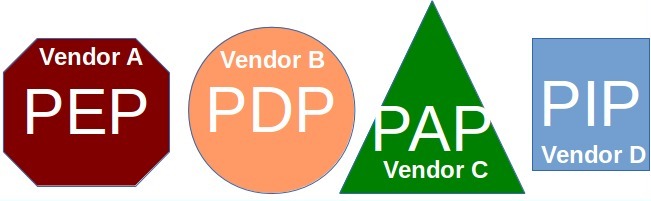
So that Vendor A’s PEP can plug into Vendor B’s PDP, and Vendor C’s PAP can plug in Vendor D’s PIP.

Why Fortress

Based on ansi incits 359, our best hope for standardizing the complete iam solution.
Using Roles for Access Control is not RBAC

I hear this kind of statement all the time:  ‘We use Roles/Groups for access control in our systems and applications so we’re RBAC’.

My response is an emphatic:  ‘No – using roles for access control is not Role-Based Access Control!’

The first is an anti-pattern, the second a best practice.  Let me explain.

RBAC is not a generic term.  It refers to a specification, ANSI INCITS 359, with explicit instructions to implement.  There are many posts that offer detailed explanation – including:

https://directory.apache.org/fortress/user-guide/1-intro-rbac.html

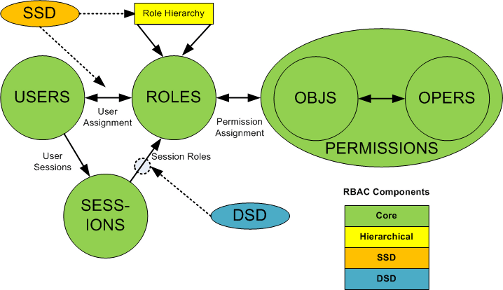
To be considered RBAC compliant an access management system, at a minimum, supports the following entities: Users, Roles, Permissions (mapping between objects and operations) and, most important – Sessions.

Sessions are the context for which role activation occurs.  Just because a role has been assigned, does not mean it should be included into a particular access control decision.

This is in keeping with the principle of least privilege:  Only give the user the power needed to complete their job at any particular point in time – and no more.

Doing this satisfies a multitude of requirements and we’ll talk about some in future posts.

So unless your access control system supports the session contextual object – stop calling it RBAC.

But there’s much more to it than that.  RBAC specification defines the interfaces necessary for CRUD and interrogation operations.  One of the most important:

userPermissions(User)

This returns all permissions authorized for a user via their role assignments.  And another:

authorizedPermissionUsers(Permission)

Crucial during audits – which users have access to a particular system resource?  If you cannot answer this question your system lacks integrity.  Many access management systems cannot accomplish these basic operations.

RBAC also defines the interface used during runtime policy enforcement operations.  For example:

sessionPermissions(Session)

This returns all permissions authorized for a user via their role activations.  Used by apps to cache entitlements during runtime.  Without the Session entity it cannot be done.   If yours cannot do this – stop calling it RBAC.

Finally there is this:

Placing roles within the access control decision paints you into a corner.  This operation usually looks something like:

isUserInRole(RoleName)  <— this is ok for coarse-grain but not fine-grained authZ

What if the roles change?  Every change requires (some variation of) a recompile and redeployment of the application.  Worse, you will need to create too many of them which pollutes your system and complicates the administration processes.

There is a better way – use a permission semantic:

checkAccess(Session, Permission)

This allows the policy enforcement point to be decoupled from the policy decision point.  If the roles needed to access that resource change, the application doesn’t.

If your access management system does not do these things – stop calling it RBAC!

More to come….